
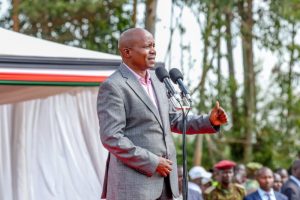
Deputy President Kithure Kindiki speaking in a past event
𝐃eputy President Kithure Kindiki has defended the government’s decision to partially sell its shareholding in Safaricom PLC and Kenya Pipeline Company (KPC), saying the move is aimed at unlocking funds for critical infrastructure development across the country.
Speaking during an interdenominational prayer service in Soliat, Sigowet-Soin Constituency, Kericho County, Kindiki assured Kenyans that the government is not relinquishing ownership of the two strategic entities but is only selling a portion of its shares to generate capital for development.
“The government is not selling all its shares in these companies. We are only reducing our stake so that we can raise resources to finance key infrastructure projects that will benefit the country,” Kindiki said.
The Deputy President explained that all proceeds from the transactions will be deposited into the National Infrastructure Fund, a newly established financing mechanism that will be managed independently. He noted that the fund will finance major development projects such as roads, dams, railways, airports, and other public infrastructure without being diverted to recurrent government expenditure.
Kindiki emphasized that the current arrangement differs significantly from previous government share sales, where proceeds were absorbed into the national budget and used to finance recurrent expenses. He said the new framework introduces strict safeguards, including oversight by an independent board, to ensure that every shilling raised is invested exclusively in long-term development projects.
According to the Deputy President, strengthening infrastructure remains one of the government’s key priorities as it seeks to improve connectivity, attract investment, create employment opportunities, and stimulate economic growth across the country.
His remarks come just days after Treasury Cabinet Secretary John Mbadi announced that the government expects to raise approximately Sh204.3 billion through the sale of an additional 20 per cent stake in Safaricom to Vodacom.
Mbadi further disclosed that another Sh103 billion is expected from the planned Kenya Pipeline Company Initial Public Offering (IPO). Together, the proceeds will be channelled into the National Infrastructure Fund to support the implementation of major infrastructure projects nationwide.
The Treasury has indicated that disbursement of the funds will commence once the independent board overseeing the National Infrastructure Fund is constituted.
The government’s plan has, however, generated mixed reactions, with supporters arguing that it provides an innovative way to finance development without increasing public borrowing, while critics have raised concerns over reducing state ownership in strategic national assets.
The government maintains that the partial sale is part of a broader strategy to mobilize domestic resources for development while preserving public interest through continued state participation in the affected companies.