
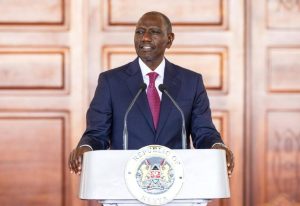
Photo: Courtesy of State House Kenya.
President William Ruto has announced plans to introduce a universal funding model that will guarantee financial support for all students admitted to public universities, colleges, and Technical and Vocational Education and Training (TVET) institutions, in what is expected to be one of the biggest reforms in Kenya’s higher education sector.
Speaking at State House, Nairobi, on Tuesday, President Ruto said the proposed model is designed to ensure that no student misses out on higher education due to financial constraints. He noted that every student who qualifies for admission through the Kenya Universities and Colleges Central Placement Service (KUCCPS) should have an equal opportunity to pursue their academic ambitions.
The President revealed that amendments to the Higher Education Loans Board (HELB) Act have already been submitted to Parliament and urged lawmakers to fast-track their approval to allow the new funding framework to take effect for students joining institutions in September 2026.
“Going forward, any student, so long as they have passed their examinations and they have been placed in a college or university, will get full funding for their higher education. It will be the choice for parents if they want to pay,” President Ruto said.
The proposed system will replace the current Variable Scholarship and Loan Funding Model, also known as the Student-Centred Funding Model, which allocates government scholarships and loans based on a student’s financial need.
President Ruto acknowledged that the differentiated funding model had failed to achieve its intended objectives, saying it placed significant financial strain on public universities.
“We tried the differentiated model, but it didn’t work because it made most of our universities almost close down. While we promised 80 percent funding, we went down to 40 percent, and most universities suffered,” he said.
He explained that although the government attempted to create a more equitable system by combining scholarships, student loans, and household contributions, the model still left many deserving students struggling to afford higher education.
According to the President, the new universal funding model will eliminate barriers that have prevented qualified students from enrolling in competitive degree programmes, particularly those requiring substantial household contributions, such as medicine and engineering.
“I want to implore Parliament to expedite amendments to the Higher Education Loans Board so that beginning September we can make sure that any child who qualifies for medicine does not fail to study medicine because their parents cannot afford to pay the household contribution,” he said.
President Ruto emphasized that investing in education remains one of the most effective ways of promoting equality and driving national development.
He noted that countries that have made significant economic progress have done so by prioritizing quality education and ensuring equal access to learning opportunities.
“Education makes us equal and has no equal. That is where we are taking this,” he said.
The President further disclosed that the government will continue engaging stakeholders and reviewing recommendations before fully implementing the new framework to ensure it is sustainable and responsive to the needs of students and higher learning institutions.
If approved by Parliament, the reforms are expected to benefit thousands of students enrolling in universities, TVETs, and public colleges from September 2026, while easing the financial burden on families and strengthening Kenya’s higher education system.
Story by Joel Esabu