
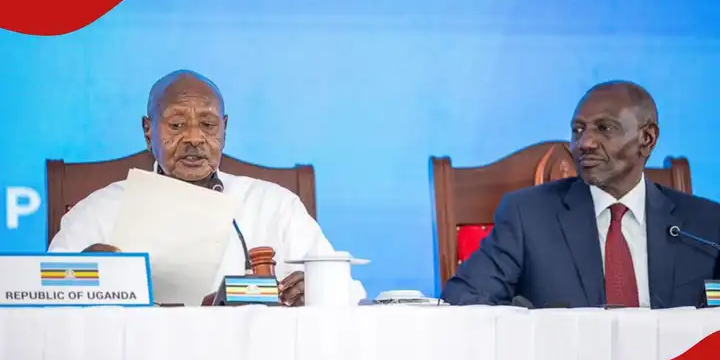
President William Ruto has strongly defended Kenya’s fuel importation framework, dismissing concerns over the involvement of intermediaries and insisting that the current Government-to-Government (G-to-G) model has significantly streamlined the procurement of petroleum products.
Speaking on September 21, 2026, Ruto responded to remarks by Ugandan President Yoweri Museveni, who had questioned Kenya’s fuel importation arrangements and raised concerns about the role of middlemen in the supply chain.
Museveni had suggested that Uganda had previously sourced petroleum products through Kenyan intermediaries instead of dealing directly with refiners and major suppliers. He also questioned whether an arrangement involving private traders could genuinely be described as Government-to-Government procurement.
Ruto, however, defended Kenya’s current model, saying the system was deliberately structured to minimise unnecessary intermediaries and enable the country to deal directly with major petroleum producers.
“One of the key things we got right was to eliminate unnecessary brokers from the fuel supply chain. Under the current framework, we are dealing directly with companies that produce petroleum products.”
The President said the decision to overhaul the importation framework was driven by the fuel shortages and foreign-exchange challenges Kenya experienced shortly after he assumed office in 2022.
He recalled that some fuel stations were running dry as oil marketers struggled to access adequate foreign currency to finance petroleum imports.
Ruto said the crisis prompted his administration to engage oil marketers and explore a new procurement model that would provide a more reliable supply of petroleum products while easing pressure on the country’s foreign-exchange reserves.
According to the President, the model has since attracted interest from other African countries seeking to address similar challenges.
“The model we introduced has attracted interest from other countries in the region. Countries such as Malawi and Burundi have approached us to understand how the system works and how it can be applied in their own markets.”
Ruto also challenged critics of Kenya’s fuel importation system to compare the actual landed cost of petroleum products in Kenya with the cost incurred by neighbouring countries.
“The most important issue is the actual landed cost of the fuel. Anyone questioning the model should compare the cost of petroleum products arriving in Kenya with the cost of products supplied to neighbouring markets. The figures will provide the clearest answer.”
He maintained that petroleum products delivered through Kenya are competitively priced and argued that the country’s current system compares favourably with alternative arrangements in the region.
“Our assessment is that the current model provides Kenya with a highly competitive supply arrangement. Petroleum products are arriving at the Port of Mombasa at a cost that compares favourably with, and in some cases is lower than, products supplied to other markets.”
The President’s remarks came as the debate over fuel procurement arrangements in East Africa continues to attract attention, particularly regarding the role of private oil companies, suppliers, traders and the terms under which petroleum products are imported.
Museveni’s earlier comments have added a regional dimension to the debate, with questions emerging over whether countries should deal directly with producers or continue relying on trading companies and other intermediaries within the petroleum supply chain.
Kenya’s Government-to-Government fuel importation framework was introduced in 2023 as the country sought to address foreign-exchange constraints, stabilise fuel supplies and reduce pressure on the dollar.
The renewed discussion is therefore likely to focus on the transparency of the procurement arrangements, the parties involved, the cost of importing petroleum products and, ultimately, the impact of the system on fuel prices paid by consumers.
For Ruto, however, the effectiveness of the model should be measured primarily through its economic outcome.
“The discussion should ultimately be guided by the facts and the actual cost of fuel. Let us compare the landed costs, examine the figures and allow the data to demonstrate which procurement arrangements are delivering value.”
By Nathan Mburu