
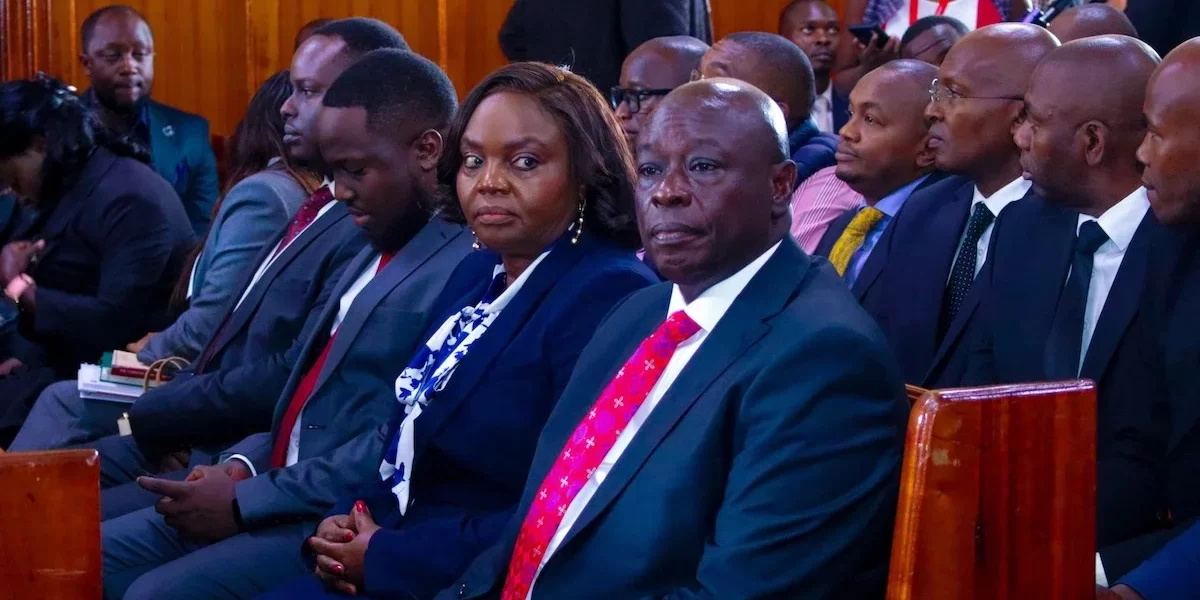
Former Deputy President Rigathi Gachagua has escalated his legal battle against his removal from office after filing an appeal challenging the High Court decision that upheld his impeachment.
Gachagua is disputing a number of findings made by a three-judge bench comprising Justices E.O. Ogola, A. Mrima and Dr. F. Mugambi in a judgment delivered in June.
At the centre of his appeal is the argument that the High Court acknowledged violations of his constitutional rights during the impeachment process but nevertheless declined to invalidate his removal.
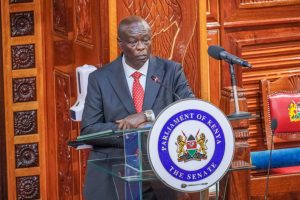
Photo: Courtesy | Former Deputy President Rigathi Gachagua in Parliament of Kenya
Gachagua maintains that the right to a fair hearing is protected by the Constitution and cannot be overridden by political considerations or procedural timelines. He argues that courts have a duty to intervene where state actions are alleged to have breached constitutional provisions.
He has further challenged the High Court’s interpretation of Article 145, which sets out the procedure for removing a Deputy President from office.
According to Gachagua, the court was right to find that investigations were an essential part of the impeachment process, but erred in its subsequent interpretation of how the constitutional procedure should operate.
Public Participation Under Challenge
The former Deputy President has also raised questions over the level of public participation during his impeachment.
He argues that both the National Assembly and the Senate failed to provide sufficient opportunity for Kenyans to participate meaningfully in the process.
Gachagua has cited Supreme Court principles on public participation, arguing that the process must be adequate not only in numbers but also in substance. He is also contesting National Assembly Standing Order 64(2), claiming that the timelines provided made it difficult to achieve meaningful public participation and protect his right to a fair hearing.
The appeal also targets the High Court’s findings on the appointment of Prof. Kithure Kindiki as Deputy President.
Gachagua argues that the court wrongly determined that public participation was not required during the nomination and approval process under Article 149(1) of the Constitution.
Alleged Changes to the Judgment
A separate issue raised in the appeal concerns what Gachagua describes as inconsistencies between the judgment delivered in open court and the final written judgment.
He claims that several additional paragraphs were read out by the judges during the live delivery of the ruling but were later missing from the written version.
The disputed portions, according to the appeal, followed paragraphs 484, 488, 503 and 508.
Gachagua argues that the alleged omission amounted to an improper alteration of the judgment and has denied him access to part of the court’s reasoning.
Ksh.50 Million Award Also Challenged
Gachagua is also dissatisfied with the Ksh.50 million awarded to him by the High Court as constitutional damages.
He argues that the amount was inadequate to address the violations identified by the court and failed to fully vindicate his constitutional rights because the impeachment itself was not declared unlawful.
He is further asking the Court of Appeal to address the question of whether a Deputy President removed through an unconstitutional process should qualify for retirement benefits.
Gachagua’s Appeal
Among the orders he is seeking is a declaration that the Senate resolution of October 17, 2024, which removed him from office, was unconstitutional, null and void.
He is also asking the appellate court to grant the remedies contained in his Further Amended Petition filed on August 13, 2025.
Gachagua wants the High Court judgment remitted for correction of the record and is seeking an order requiring the High Court Registrar to include the portions he says were read in open court but left out of the written judgment.
He has also asked the Court of Appeal to award him the costs of the proceedings.
The appeal places Gachagua’s impeachment once again before the courts, with the Court of Appeal now expected to consider whether the High Court properly applied constitutional safeguards during the process that led to his removal.
Story by Joel Esabu