
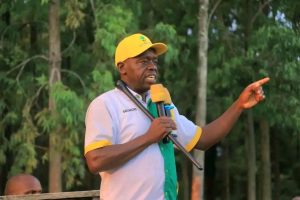
 UDA candidate David Kipsang Keter, popularly known as Dollarline, won the Emurua Dikirr parliamentary by-election, handing President William Rutos party a crucial victory in a contest that also exposed the changing political mood in the South Rift. Keter was declared winner after polling 18,266 votes, defeating DCP candidate Vincent Kibet Rotich, who garnered 10,760 votes. Other candidates trailed far behind, with Gideon Koech of NVP getting 190 votes, Cherono Desma of PNU 80 votes, and Kiprono Rotich of RLP 62 votes. The race drew 29,358 valid votes from 44,353 registered voters, translating to a turnout of 66.6 per cent across 94 polling stations.
“To the great people of Emurua Dikirr,Iam truly grateful for the trust and opportunity you have given me to serve you as your member of parliament. Thank you everyone who stood with us, prayed for us, supported us, and believed in this journey in one way or another,” David Keter said.
The result gives UDA the seat once held by the late Johana Ngeno, whose death triggered the by-election, but the numbers also tell a deeper political story. Emurua Dikirr has for years been shaped by Ngenos personal political influence, with David Keter repeatedly falling short in previous contests despite steadily growing his base.Figures shows Keter moving from about 7,000 votes in 2013 to 13,707 in 2017 and 14,596 in 2022, while Ngeno remained dominant in the area.
Even so, the by-election was more than just a UDA retention race. It was widely seen as an early political showdown between allies of President William Ruto and former Deputy President Rigathi Gachagua, whose Democracy for Citizens Party (DCP) is trying to gain a foothold in Rift Valley politics. While DCP did not win the seat, its candidates 10,760 votes signaled that the party has already become the main challenger to UDA in the constituency.
Rigathi Gachagua praised Vincent Rotichs performance, describing the DCP showing as a major statement in South Rift politics and arguing that polling over 10,000 votes in the constituency was no small achievement.
On the UDA side, leaders allied to the ruling party moved swiftly to present the outcome as a validation of both Keters personal persistence and the partys continued grip on the region. Narok Governor Patrick Ole Ntutu said the victory reflected residents confidence in Keters leadership, while Oscar Sudi, Nelson Koech, Aaron Cheruiyot, and former Cabinet Secretary Simon Chelugui were among those who publicly congratulated the MP-elect and urged him to focus on service delivery and development.
Still, beyond the celebrations, the by-election laid bare the issues likely to shape the constituency’s politics going forward. During the campaign, residents and observers repeatedly pointed to concerns over roads, hospitals, general infrastructure, indicating that development, not just party loyalty, is becoming central to voting behavior.
In the end, Emurua Dikirr delivered a clear winner, but also a warning for the future. David Keter and UDA won the seat comfortably, yet DCP emerged as a credible opposition force, making the by-election less a final verdict and more the opening chapter of a broader struggle for influence in the South Rift. For now, Dollarline heads to Parliament with a mandate. But the political message from Emurua Dikirr is equally clear: the region is still UDA territory, though no longer without competition.
By Emmanuel Kirui